
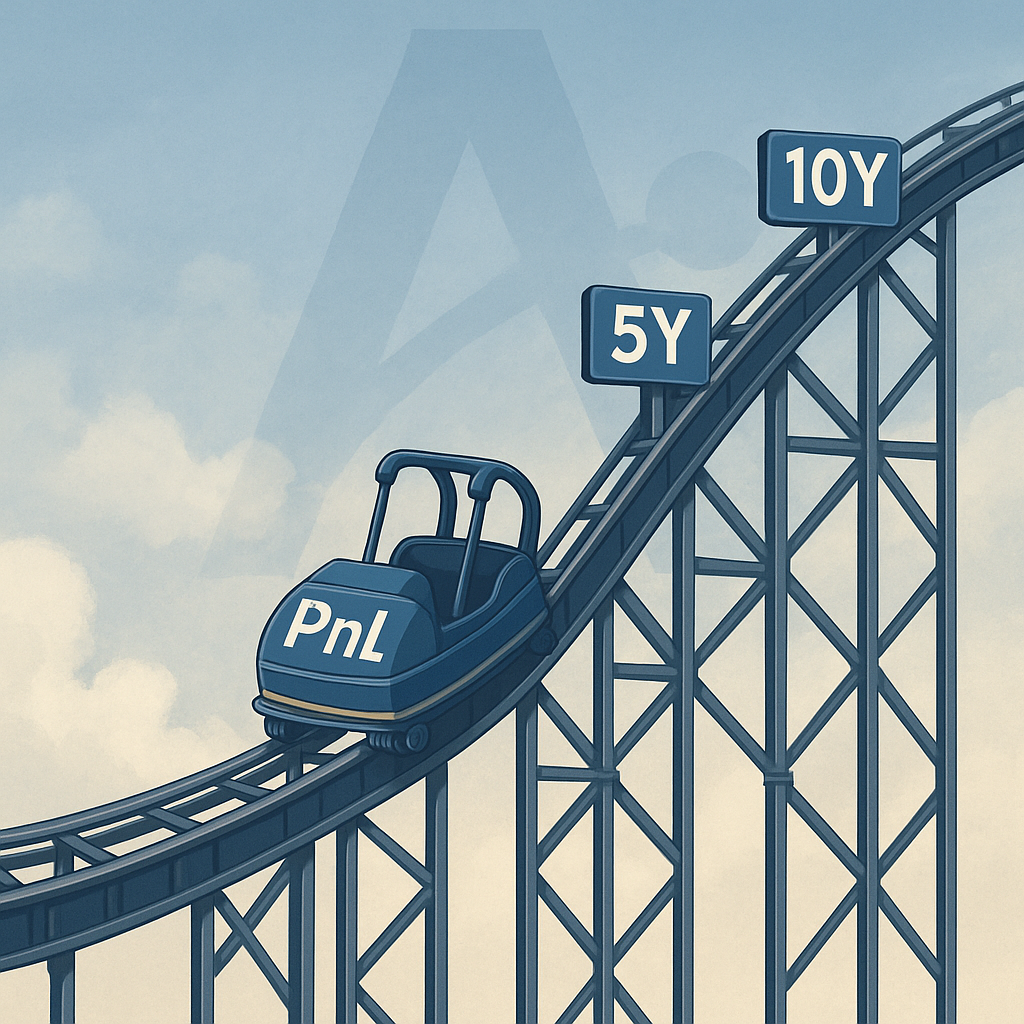
A practical guide to managing DV01 curve risk. DV01 is just the map – but without contour lines. Curve roll, carry, and forwards determine the path your PnL actually takes.
DV01 is only the starting point when managing interest rate risk. As positions roll down the curve, DV01 decays and carry is a major driver of PnL. Using real examples of 5y10y curve spreads and 5y5y forwards, I show why understanding the evolution of risk over time is crucial for traders.
Definitions
We must first clarify what we are talking about here:
- Outright risk – this is the exposure of a Rates trading book to the outright level of rates. If Interest Rates move up by 1 basis point, what is my expected PnL. See Derivatives PnL Explained for more.
- Curve risk – What tenor of interest rates are we talking about? Any portfolio will have a different sensitivity to 1 day SOFR, to 3 month SOFR futures to 30 year USD swaps. Curve risk must be managed as a result of having different risks at different maturities along the interest rate curve.
A Real Example – 5s10s
Starting with the basics, in DV01 terms a 5y vs 10y trade looks like the below:

Showing;
- A 5y10y curve trade in $100k of DV01.
- The 5y10y price is the difference between the 10y and 5y swap coupons.
- The 5y10y spread was 32 basis points yesterday (3.61% minus 3.30%) and closed at 31 basis points today.
- It is represented in terms of DV01 risk in the corresponding tenor buckets and draws on my explanations of Derivatives PnL.
- This is a “flattener”. If 10y rates fall more (or go up less) than the 5y rate, this position will make money. Hence 5y10y moving from 32 to 31 results in a positive PnL of $102k.
- A “steepener” would have a positive DV01 in 10y, with equal and offsetting negative DV01 in 5y.
- A steepener then makes money if 10y rates go up more (or go down less) than 5y rates.
- It is unusual for the DV01s to be exactly equal – there is no “standard curve” to calculate DV01s. In the real world, notional amounts are rounded to the nearest million so you end up with a small residual outright risk as well.
Why have I presented this in the same way as Derivatives PnL? Because:
- A 5y10y doesn’t stay as a 5y10y position for very long!
- Every week, the 5Y risk decays by 0.4% and the 10Y by only 0.2%.
DV01 Decay
Fast-forward a month and the risk doesn’t look so “compartmentalised”:

Showing;
- No new trades have occurred! The 5Y trade, after one month, has only 98.4% of the original 5Y period left. The 10Y still has 99.2% left.
- This is stating the obvious: a 5Y10Y position is not held to maturity. The 5Y leg expires 5 years earlier than the 10Y, so the trade stops being a curve position.
- Happily, we are in a SOFR and OIS world these days. Otherwise we would be talking about mis-matched fixing risk in the short-end as well.
- As well as the net risk changing, the delta is exposed to other idiosyncrasies now. Not just 5y10y but 4y9y as well.
- As a result, even with 5y10y back to it’s original level of 32 basis points, my overall PnL is non-zero.
- I expect to have made $19 in a month even though the market is back to its original level.
Carry
After holding this position for one month, I still haven’t made any cashflows. SOFR swaps trade on an ACT360 Annual basis on each side. Therefore there is only one single net cashflow to exchange each year. Step-forward “carry”.
Definition: Carry is the PnL of a trade as a result of doing nothing. It is the PnL of a trade due to the passage of time alone.
For a 5y10y, the carry is non-zero:
- The main component of carry is the “roll-down” along the curve in this case.
- When I entered into the trade, 5y10y was 32 basis points. 4y9y was 30bp.
- Swaps traders are inherently lazy – they prefer to earn money by doing nothing.
- Receiving this 5y10y is a good example of positive carry. If I do nothing and the market does nothing for 1 year, I will end up with a 4y9y spread at 32bp, which is marked at 30bp. I will have a 2bp profit on about $90k DV01 of risk = $180k per year.
When is a 5y10y not a curve trade?
Look at the below DV01 risk:

Is it still a 5y10y trade? Yes, it has exposure to the 5y10y slope, but also to outright rates:
- This is the risk exposure of a 5y5y forward. A 5y swap that starts in 5 years time.
- It is a leveraged position. What does that mean in practice? If I roll this position down the curve for one month, with rates back to unchanged, I see a very different net PnL to 5y10y decaying by one month:

Just consider what has happened:
- Rates are unchanged, we are just one month later.
- My expected net PnL for the 5y10y was $19. For this 5y5y, it is $838. How can a position generate 44 times the PnL of a simple curve spread when the market hasn’t moved?
- Answer: A steep forward curve. The 5y5y is decaying to a 5y4y (a 5Y swap that starts in 4 years time). The difference in those two coupons over one year is about 14 basis points (3.92% to 3.78%).
- The carry on the 5y5y will be more like $690k per year/$57k a month. For doing nothing!
A Map Without Contour Lines
DV01 risk is only a projection of the risks you are running. It is like looking at a map without contour lines.
There are therefore myriad other complications when you try to hedge risk in the real world. For example, if you like smooth forwards, then the shape of the 9y-10y curve may also rely on the shape of the 10y-12y curve. Therefore, the day after trading a 10Y swap, you suddenly have 12Y risk as well.
The key point is this: not all market participants see the same risk. A hedge fund can very happily run highly leveraged forwards, with a lot of DV01 bucket noise, knowing that they will novate out and end up with a clean book. Market makers do not have this same luxury – there is always another client waiting to trade.
In Summary
- Question: What is curve risk?
Answer: Curve risk is exposure to relative rate moves between maturities. A book can be neutral to outright levels but still sensitive to the slope between, for example, 5Y and 10Y. - Question: Why does DV01 “decay” matter?
Answer: A 5y10y trade never stays 5y10y. As time passes, each leg rolls down the curve at a different speed, creating new DV01 exposures even when the market is unchanged. - Question: What is carry in a curve position?
Answer: Carry is PnL from doing nothing – the return generated purely by the passage of time. Curve trades often make or lose money as they roll into different parts of the curve. - Question: What makes a forward swap riskier than a simple curve spread?
Answer: A forward (such as a 5y5y) is a leveraged expression of curve shape. It decays into a shorter-starting swap whose coupon may differ dramatically. This can create large PnL swings even when rates are unchanged.


Leave a Reply