
Capital One recently received approval for its acquisition of Discover and in this post I use Google Gemini to dive into the financial details and competitors
Background
On 18 April 2025 Capital One received approval for the $35 billion acquisition of Discover. This will create the sixth largest US Commercial bank with $632 billion in consolidated assets, just above Goldman Sachs with $558 billion and below US Bank with $662 billion. (Figures as of Dec 31, 2024 from Federal Reserve).
You may have seen the story covered in the financial media e.g. Bloomberg, Financial Times, New York Times and many others.
The detail in such articlea may be sufficient for you to move onto the next story, another Trump policy change anyone…. but at times you will want to know more and turn to Google Search to find more articles.
While many of these articles will rehash the same ground, some will provide different insights and with time and perseverance you can find more in depth ones, assuming they are not behind paywalls.
Can you do better with AI Chat?
Let’s find out.
Financials
Starting with what interests me most, financial numbers and competitor comparisons.
Using Google Gemini 2.5 Pro, I entered the following:
For the Capital One, Discover merger what are the key consolidated financial metrics when the entities are merged and how do these compare to the two nearest competitors
Which cycles over its thinking steps:
- Identify the key financial metrics
- Identify the merged entity
- Identify the two nearest competitors
- Formulate search queries
- Execute search queries using the tool
- Synthesize the information
- Format the response
All these look good and it came back within a minute with it’s analysis.
However I was not happy that for step 3 JP Morgan Chase and Bank of America were selected, based on the following thinking process:

Both these are far larger and more diverse groups, so I asked it to use American Express (Credit Card focus) and US Bank as the competitors, which was easy to do.
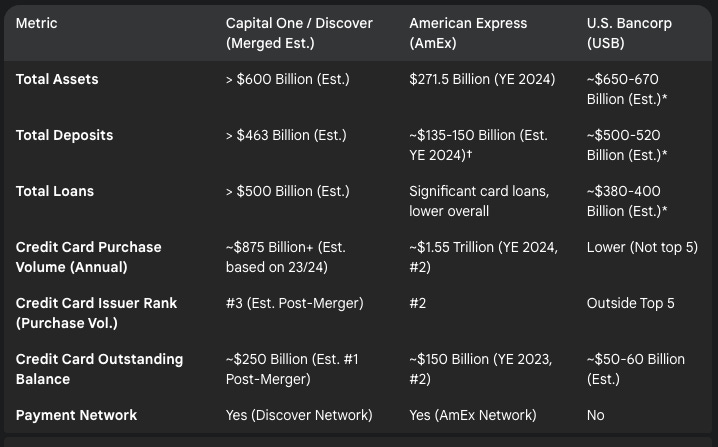
And got the following Comparison table in the response.

- The choice of Assets, Deposits, Loans metrics here is good.
- The response does include the statement “It’s challenging to provide exact pro forma consolidated balance sheet figures without official post-merger reports. However, we can estimate the scale based on recent individual company data and market rankings”.
- The choice of three Credit Card metrics is also good, as the response states that “credit cards are a key driver for this specific merger.”
And the response ends with:

A nice analysis that also highlights the potential opportunity in Capital One moving Credit Card volumes from the Vida/Mastercard network to Discover.
Profits
And what about profits?
Let’s ask:
Can you show a table of profitability measures such as EBIDTA, Net Margin, Return on Equity and others for the most recent financial year for the merged Capital One and Discover entity and compare these with American Express and US Bank
Which returned the following table:

Not bad, but lots of cells with Data Not Found.
A list of Sources is also returned:
- Capital One: Q4 2024 Earnings Release, Q4 2024 Earnings Presentation
- Discover: Nilson Report Summary, Q4 2024 Earnings Release, Finbox ROE Data
- American Express: AmEx 2024 Annual Report Snippet, Q4 2024 Earnings Release, Finbox ROE Data (Competitor Benchmark)
- U.S. Bancorp: Q4 2024 Earnings Release
And checking these, I can see that some of the Q4 2024 releases e.g. Capital One include full year 2024 financials and others do not e.g. Discover.
So I tried to improve this by asking:
Can you use SEC filings to get the data in this table?
The results started with the comment:

Nice, SEC Form 10-K is what I wanted it to use.
However the table returned below, had a few cells with “Not Found in Snippet”

And the last note in the results explains why:

Fair enough, I would now need to download the 10-K filings and load the full documents into the context window and see if that completes the table.
I expect it would, with some careful prompting.
But for today, lets move on.
Capital
Next, lets ask about Capital, a key concern for banks.
Can you show a table of capital adequacy measures such as Capital, CET1, RWA and other measures for a recent financial quarter for the merged Capital One and Discover entity and compare these with American Express and US Bank
Unfortunately the table returned had a good number of the metrics I expected, but all the cells returned with “Not Found in Snippet”.
So, I tried the below (as I know these reports contain such metrics)
Use the dedicated Basel Pillar 3 Disclosure reports to get the data for the table
And the response stated the following:

So the same limitation, I would need to get the pdf documents and upload these.
I did that for Capital One report and entered:
Attached is the Basel Pillar 3 report for Capital One, using the data in this populate the above table just for Capital One

Nice, this is what I wanted and looks healthy.
I could now download reports for the other banks and get the full table, but no need as you get the idea.
Let’s end todays blog there.
Learnings
When reading a news story, we often want more depth.
Generally we would use Search to find other articles.
This takes time but generally works fine.
An alternative is to use AI Chat.
Google Gemini works well for this.
It is a reasoning model, so thinks in steps and performs search and synthesises results.
Then we can ask questions to drill into any aspect we want.
There are limitations with data not in search results.
Such as is common for financial results.
This then requires documents to be uploaded into the AI Chat.
To continue our deep dive.
The AI Chat alternative to Search is one we all need to get familiar with.
And use as the situation demands.
That’s all for today.
Leave a Reply