
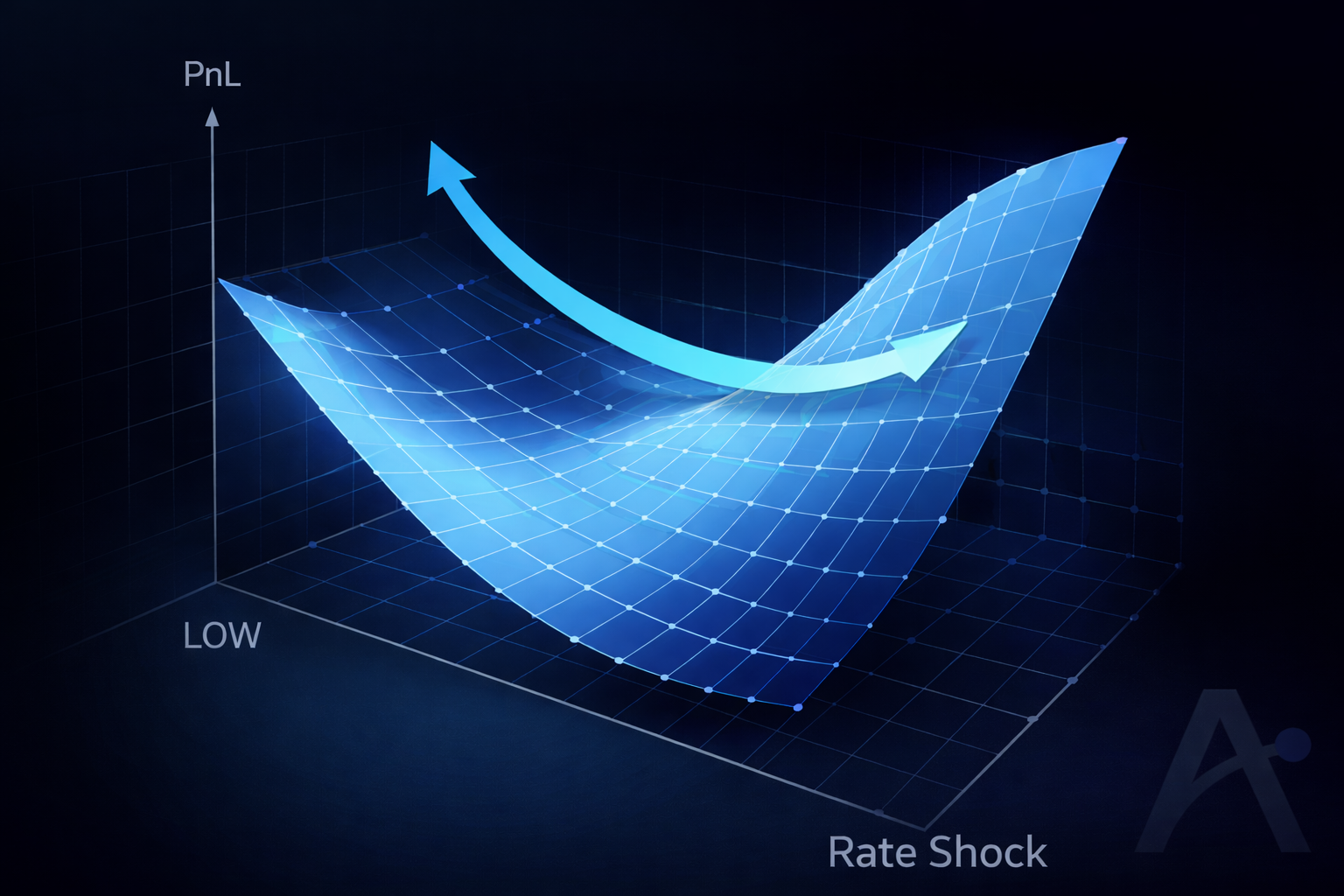
The real second-order risk in swaps is not convexity.
It is discounting.
When rates move by 50bp, desks start talking about convexity. Let’s see if they should.
The FT reported that the “US bond market shows signs of strain“. Interest rate futures are no longer pricing rate cuts in 2026 and 10Y UST yields topped out on Friday.
These big rate swings – whether up, down or trading in large ranges – tend to bring second-order risks in derivatives trading to the surface.
So should I be worried? Or should this be treated as “business as usual” for the trading community?
I am worried about convexity
Matt Levine is one of my favourite columnists, and he frequently highlights when people are worried about something. But this time around, I’ve not seen him worrying about convexity risk, despite a 50 basis point rise in yields (and more at the short-end).
I wanted to know why, so I ran some numbers on a 10 year swap. Here is how the DV01 risk and PnL on a $100m 4% 10Y swap respond to a rate shock of +/- 150 basis points:

And the PnL:

This shows;
- A $100m 10 year swap with a 4% coupon against a hypothetical OIS curve (not at current rates, the 10 year break-even is about 2.72% on my curve).
- Whilst we start with a DV01 of $94k, this decays by about $3k DV01 per 25 basis points of outright rates. That sounds meaningful, but it translates into only modest PnL asymmetry even over large moves.
- It falls to $81.7k after Rates have increased by 150 basis points, a full 14% lower than where we started.
- On this pay fixed position, I would earn $15.1m if rates fell by 150bp, or lose $13.2m if they rise by the same amount.
This is not carry or roll-down. This is the change in an outright position as a result of changes in outright rates. But it really isn’t enough to worry about:
- You can see that the charts are roughly linear even across a 300 basis point range.
- I can sleep relatively easily at night that a hedge I put against this trade will react in a close-enough manner (e.g. a receive fixed swap with an at-market coupon).
- For example, I would need to trade $106m of a 10Y par-swap to hedge this $100m 10Y 4% trade (the larger coupons of an off-market swap create interest rate risk). A simple par swap hedge is “good enough” – even across large rate moves. Within 300 basis points the PnL ranges from $-15.2m to +$13.1m.
It is really only when we start looking at a PnL range of 800 basis points that you can see the non-linear impact of rate moves on risk:

Convexity in a vanilla swap is real – but it is not economically significant over realistic rate moves. Where convexity could be interesting:
- A large change in outright rates could be enough to change the cheapest to deliver bond for bond futures resulting in heavy repositioning in cash-futures basis trades. The maths is covered here.
- Mortgages are “convex” in that remortgaging occurs when rates move lower. This baked-in optionality in Mortgage Backed Securities (they get shorter when rates go lower and longer when rates go up) causes significant amounts of re-hedging. Some of that activity occurs in swaptions as opposed to outrights.
So if convexity isn’t the risk… what is?
I am worried about discounting risk
My worries don’t end there though. As my blogs on PnL and carry highlight, it is second-order risks that keep me up at night. I checked convexity to slope risk – again, nothing to see there.
But discounting risk is very real. Take a look at the mark-to-market impact of a +/-30bp shock to my discount curve:

Why do I raise this point?
- I define discounting risk as the DV01 exposure arising from using a different discount curve to your forecasting curve.
- A SOFR swap is not necessarily a SOFR-discounted swap.
- This is the risk that cross currency traders run – discounting all non-USD cashflows back to the USD base curve.
- But discounting risk exists for all swaps:
- Most notably as basis risk when your forecasting curve is different to your discount curve. This is common in EUR swaps (Euribor with an €STR discount curve) but also in bilateral USD swaps (SOFR or Fixed rates with a CSA-linked Fed Funds discount curve).
- It also exists as a result of off-market fixed rate coupons, large spreads on floating rates and even just vanilla swaps as they age (and are hence no longer at-market).
In the USD market right now, the most significant discounting risks are likely to live within cross currency swaps with a fixed USD leg on a bilateral Fed Funds CSA. Outside Swaptions, most other USD rates risk is cleared – therefore the forecast and discount curves are both SOFR-linked.
Even a simple $100m swap like this sees an $8.5k change in PnL per basis point of Fed Funds/SOFR basis. This has two impacts on market activity:
- More hedging has to take place, even when liquidity conditions are sub-optimal.
- Liquidity conditions are sub-optimal because desks are trying to keep a handle on these second-order risks when rate moves are large.
Better understanding of PnL drivers – and better visibility of swap book risks – makes these second-order effects easier to manage.
In Summary
- Question: Should traders be worried about convexity in vanilla swaps?
- No – convexity exists, but over realistic rate moves it has minimal impact on PnL.
- Question: Does DV01 change as rates move?
- Yes – DV01 decays as rates rise, but the effect is gradual and does not materially distort hedge performance.
- Question: Will a simple DV01 hedge break down in volatile markets?
- No – a par swap hedge remains “good enough” even across large rate ranges.
- Question: So where is the real second-order risk?
- In discounting – differences between forecasting and discount curves (e.g. SOFR vs Fed Funds) create meaningful, hedgeable PnL exposure.
Leave a Reply