

Transparency, wider access to clearing, and predictable costs when markets are most volatile will make repo more resilient
The Bank of England this week announced a discussion paper on repo markets (which de-railed my plan to look at Repos in the US, but more FOCUS reports will be coming!):

This has been expected from the beginning of the summer. You can even learn what AI has to say about it in my video.
Today, I will cover:
- What’s in the consultation/discussion paper
- The data available from Actrix to answer the points raised and;
- What I would like to see
What’s in the Paper?
- I learned that we are not at the “consultation” phase yet. Apparently discussion papers come first now – news to me!
- Much of the data is sourced from the Sterling Money Markets Data collection, and not SFTR data. See this blog for some of the limitations of SFTR data.
- Average Daily Volumes in gilt repo have increased from ~£150bn in March 2018, to £225bn in Q1 2025 (quarterly data available here).
- Much of that ~50% growth in volumes happened between 2018 and 2020, with daily volumes having stabilised in a £205-250bn range since.
- Similarly, repo outstanding stands at about £1trn and has done for the past ~five years.
- 98% of volumes are intermediated by a dealer.
- The Triparty market is very limited in the Gilt market.
- 23% of gilt repo was cleared in 2025 Q1 (which is surprisingly consistent with SFTR data, despite the public data failing to delineate by currency and double-counting cleared volumes).
- Comparing to other markets, 20-30% of UST repo is voluntarily cleared, 60% of JGBs and 60% of EGBs (ranging from 72% in Italy to 27% in Sweden and lower elsewhere).

What Does Clearing Bring to the Market?
Reading between the lines, the reason that the BoE (regulators in general?) like the idea of clearing:
- In volatile markets, end-users (i.e. not dealers) are likely to want to increase their use of repo. This is because they will want to lend securities to raise cash in order to meet margin calls on cash-collateralised positions – such as futures and OTC derivatives.
- Because dealers intermediate most of the market, clients need to ask a dealer to increase their repo position in volatile markets.
- This means that dealers are asked to take more credit risk when things look riskier. This is collateralised credit risk, so far less risky than unsecured lending pre-GFC, but it is still risk.
- The uptake of clearing by clients has been limited in gilt repo markets.
- That means that dealers miss out on the multilateral netting benefits of clearing on their balance sheets. Even if they have one client asking for more cash and another client looking to borrow the same underlying gilt, a dealer cannot net these positions on their balance sheet. They gross up, meaning that balance sheet costs increase when markets are volatile. Not great.
- Add to this that dealers may change margin requirements (from near zero to something) in volatile markets. Suddenly, the cost of the extra repo for a client in volatile markets becomes quite a big unknown.
- Clearing simplifies things:
- Standardises margin amounts (courtesy of a suitable margin model which gives more than a passing nod to pro-cyclicality).
- Increases netting for dealers, reducing costs more when markets are busiest.
- Standardises margin funding – with CCP cut-off times, the market knows where it is, rather than hanging around waiting for a counterparty to make a margin call.
- It also removes the “first to blink” syndrome, where dealers may hold back out-going margin payments until they are confident there is no credit event about to happen.
The Basis Trade
Elsewhere, the Bank of England is worried about the basis trade in Gilts. And you can see why from the July 2025 Financial Stability Report, that shows the big increase in positions in the past 18 months:

Non-Centrally Cleared Repo
Sections 3.3 and 3.4 of the of the paper consider minimum margins for uncleared positions. We know from looking at OTC derivatives that the uncleared margin rules were successful in pushing a number of FX, Inflation and Rates derivatives into clearing.
Transparency
Section Four of the paper covers “other potential measures to enhance gilt repo market resilience”, away from greater use of central clearing and minimum margins.
Within this, greater transparency is mentioned. This should be a key consideration for any responses to the BoE. As I have been working with the UK SFTR data in anticipation of this paper, I created a rich dashboard of the UK repo market;

However, the SFTR public data provides limited transparency. Two small improvements to this regimen should include:
- Add currency as a reportable field. This is really important to be able to understand the data. Take Repos for example – we don’t know whether the underlying is a Gilt or a UST or an EGB etc!
- Resolve double-counting of cleared volumes – this is easily solved for UK CCPs (add a CCP flag as the reporting counterparty type).
It is also notable that the data being published by LCH’s RepoClear is nowhere near as rich or usable as the equivalent published out of LCH’s SwapClear. CCPs should really be publishing daily data, by currency, for repo clearing.
What Did They Miss?
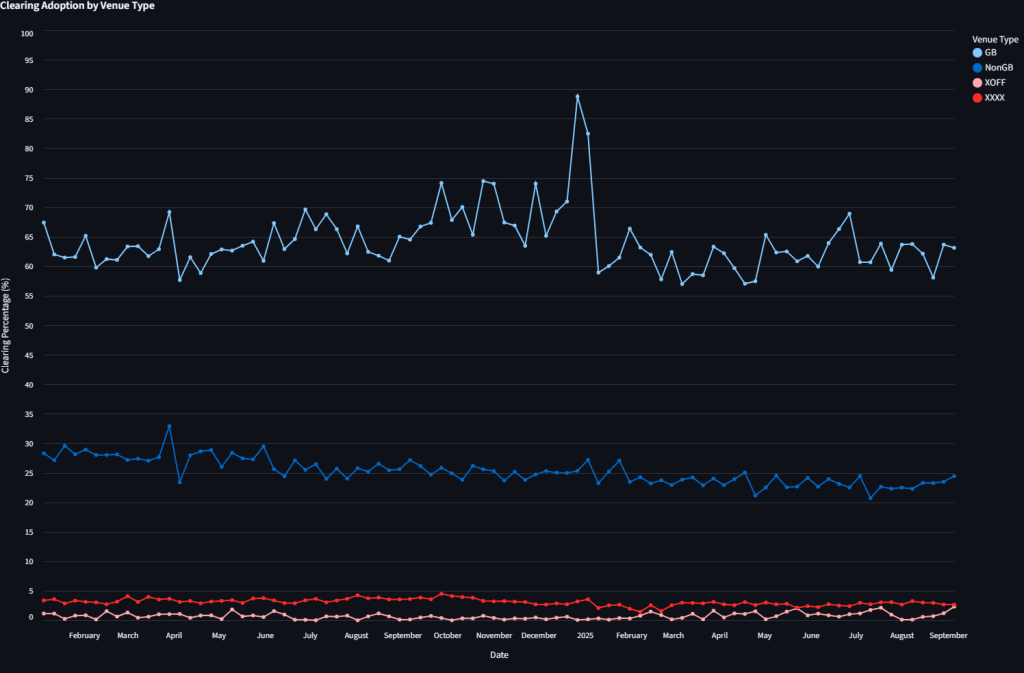
The adoption of repo clearing varies massively depending on which trading venue the repo is executed on. Clearing is basically non-existent for trades executed off-venue, something that should be addressed:
My wish-list
Following the well-trodden path of regulatory reform, I think there is quite an obvious path:
- Improve transparency. Market participants need a rich overview of the market to fully understand the impacts of any potential changes.
- Use incentives to motivate voluntary clearing (netting benefits for dealers, margins on uncleared positions for clients).
- Ensure that access to clearing is readily available. The shockingly low clearing rate for off-venue trades is surely a concern – even more so because it accounts for most of the volumes.
All the time, remember it is very hard to get market participants to change what or where they trade. Reform in the post-trade space is much easier to achieve than in the pre- or at-trade point of the trade lifecycle.
In Summary
- BoE Discussion Paper: The Bank of England launched a paper on strengthening gilt repo resilience, highlighting low levels of clearing (23%) and reliance on dealers to intermediate ~98% of volumes.
- Clearing Benefits: Central clearing would bring multilateral netting, standardised margining, and reduced balance sheet costs during volatility – addressing potential repo market vulnerabilities.
- Transparency Gaps: Current SFTR and CCP data lack key details (currency flags, double-counting fixes, daily breakdowns), limiting effective market oversight.
- Wish-List Reforms: Improve transparency, incentivise voluntary clearing, expand access (especially off-venue), and focus on post-trade reforms as the most achievable path.
Leave a Reply