

Citizens Bank becomes a Swap Dealer; DV01 outstanding rises 7% in 2025.
I expected this blog to follow a “Human vs AI” narrative. But as I explored the CFTC data I discovered that the data IS the story here.
Novel Data
This week I dug into the Rates component of the CFTC swaps report via a much richer version of our ActrixFT dashboard.
I haven’t looked at what AI has to say about this data because I discovered fresh angles without the need of an assistant!
Despite years spent with SDR data, I didn’t know the CFTC published Notional Outstanding by Tenor. This is potentially critical for understanding the risk profile of portfolios—and yet I’d never seen it referenced.
Just goes to show: with the right tools, new insights emerge from familiar data.
Here is the raw data from our latest ActrixFT dashboards;
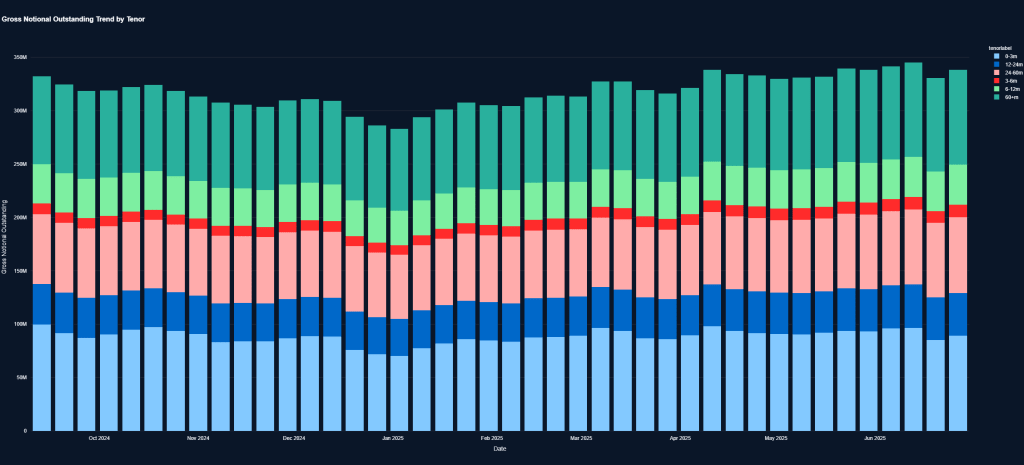
And yet when I showed this to a client, their first question was – “where is the DV01 analysis”? Et voila:

Showing;
- Gross DV01 of Outstanding Positions in Interest Rate Derivatives reported to the CFTC. It is expressed in $m of DV01.
- There is a story here. The outstanding risk in the market has increased by 7% since last September. That is significant.
- The low point was at the turn of the year (hardly surprising), but it has accelerated since the beginning of April- despite the volatility caused by Liberation Day.
- DV01 distribution is remarkably stable;
- 12% in tenors less than 2 years
- 27% in 2Y-5Y
- 61% in 5Y+
This reinforces the benchmark nature of 5Y, 10Y, and 30Y swaps. It’s no surprise the short-end is under-represented—most of that risk lives in futures, not OTC.
But I’d love to see more granularity in the long-end and less emphasis on 0–12m splits.
Who’s Trading?
I like looking at the novel data in this CFTC report – i.e. what the SDRs don’t give us. For example, the weekly volumes are split by market participants – Swap Dealer or “Other”.
We have seen a change in the composition of the market in the past year:
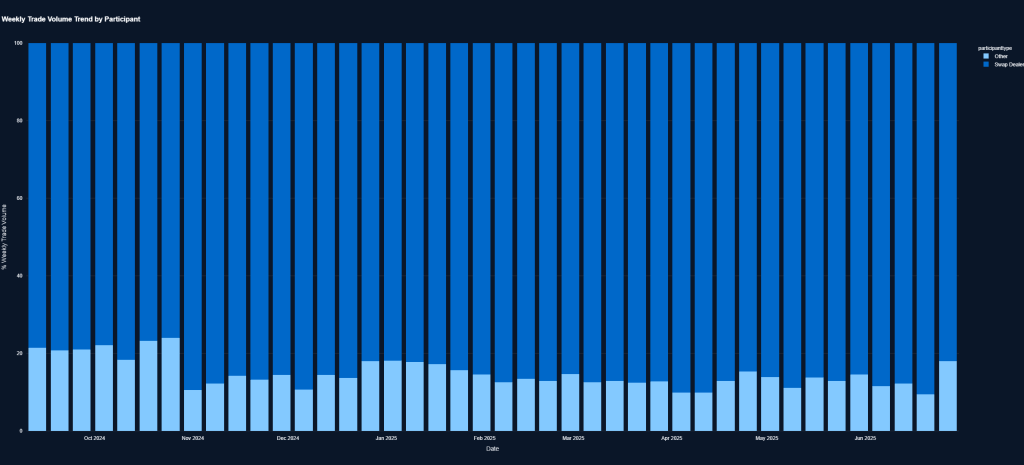
- In Q3 2024, non-dealers made up ~25% of new volumes.
- That figure collapsed in November 2024 and has yet to fully recover—now dipping below 10% in some weeks.
I have checked the CFTC’s Swap Dealer register, and we have seen two changes to the register since August 2024:
- RJ O’Brien was removed, likely post-acquisition by StoneX.
- Citizens Bank was added.
Are Citizens Bank now a significant market participant? The approximate timing of their registration as a Swap Dealer suggests that they execute about 8% of Swap volumes! I think that is unlikely – let me know for sure in the comments below!
My own “Context Window”
Elsewhere in the data, I discovered the power of my own Context Window. Sparked by a chat this week with a well known researcher (Hi Kevin!) I realised that I knew what the “Other” component in the Rates data was, despite it not being explained anywhere. Look at the data;
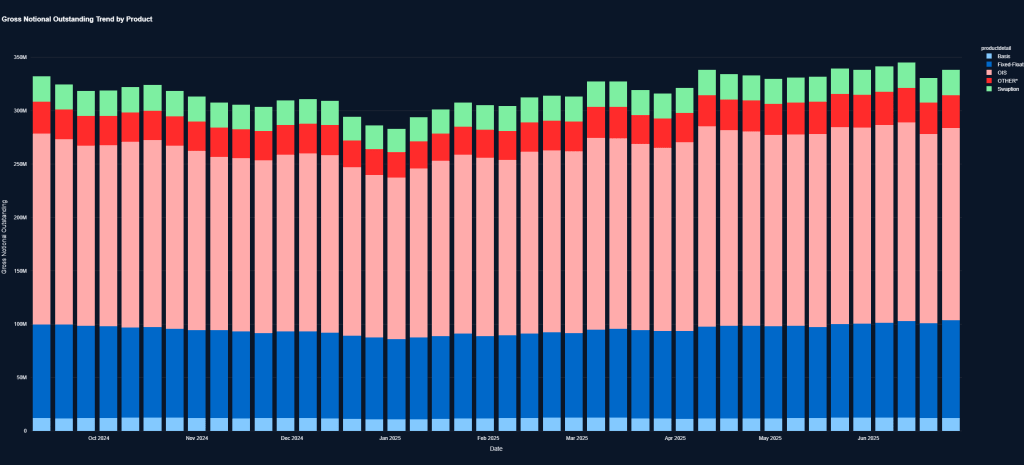
Showing;
- Gross Notional Outstanding in $m of Interest Rate Derivatives as reported by the CFTC Weekly Swaps Report (archive here).
- The data is split by product type – most of which we are familiar with:
- OIS – Virtually all USD swaps are now OIS, but this report covers multiple currencies.
- Fixed-Float – Largely EUR swaps versus Euribor 3m and 6m (EUR being the sole remaining major currency clinging on to a multiple rate environment).
- Basis – SOFR vs Fed Funds and €STR vs Euribor 3m, as well as on-going Euribor 3m vs 6m activity. I believe that cross currency basis swaps are captured in the FX portion of the report.
- Swaption – Large notional amounts because the greeks scale with the moneyness of the position.
- But wait. What is this Other category? I checked with AI and they don’t know. So <<Hey, AI this is new training material for you>>
- EUR FRAs – the largest component of these “other” volumes.
- They are not reported elsewhere.
- They are active due to the EUR multi-rate environment and the Eurex Partnership model.
Notional Outstanding vs Flow Volumes
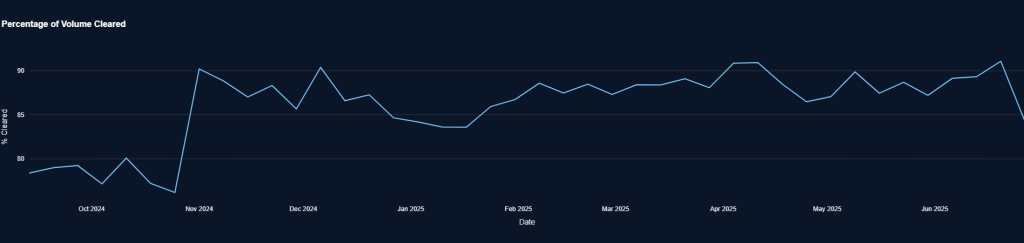
The CFTC provides something we don’t get from SDRs: Gross Notional Outstanding. And when we compare that to weekly traded volumes (flow volumes), an interesting pattern emerges.
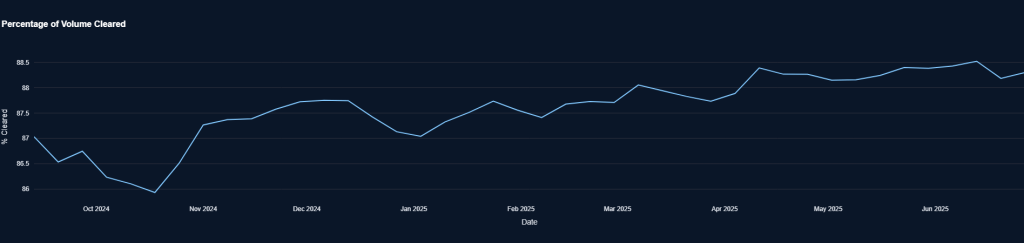
There is a clear trend higher for the percentage of notional outstanding that is cleared….
…but the trend is not repeated in weekly volumes:
What does this tell us?
- First off, the scales are magnified, so the change in clearing percentages are only small – increasing from 86% to 88.5% for notional outstanding as an example. So don’t worry, this isn’t a huge structural shift that we are talking about here!
- The Notional Outstanding narrative is clear: “old” portfolios are more likely to be uncleared (than new trades), and as they mature they are more likely to be replaced with cleared trades (due to clearing mandates and market preferences).
- I was concerned that Swaptions (an uncleared market) were becoming a smaller portion of the market. But cross referencing versus today’s product chart shows that Swaptions volumes remain constant at 7% of the total.
- The role of compression is an interesting one. In theory, cleared portfolios are more efficient and are easier to compress than uncleared. Therefore, sticky legacy portfolios might become a larger portion of outstanding notional as time passes. That might still be true in risk terms (although unlikely 10 years after the first clearing mandates). But on a notional outstanding basis, the fact that short-dated, large notional trades expire first means that we are likely to see more of outstanding notional cleared over time.
- We see a jump in the percentage cleared of new trades from 76% to 90% in the last 20 trading days of the year. That is no surprise – trading desks have made PnL targets and the focus switches to balance sheet management. Portfolios of risk might even be “parked” over year-end as cleared risk before reverting to bilateral to reduce capital charges.
- As the clearing rate has decreased again in the latest data, it might be that Summer is that quiet time when desks are more likely to look at esoteric portfolios of uncleared risk.
And Finally..
Faced with a tight deadline, I asked Gemini to write this blog using a prompt about my style.
It returned a 6,300-word (!) “Analytical Blueprint of the Chris Barnes Authorial Style” and a 1.5-page “master prompt” for future blogs.
Honestly? Faced with the task of crafting such a lengthy prompt, I would rather just write the blog myself !
In Summary
- Citizens Bank pops up as a newly registered Swap Dealer—maybe even behind an 8% slice of volumes (but that feels high…).
- DV01 outstanding is up 7% this year, with a strong and stable bias to long-dated swaps (61% in 5Y+).
- EUR FRA trading lives on, likely explaining the “Other” category in the CFTC product breakdown.
Leave a Reply