
AI Chat Apps have selectors for LLMs and today I look at the types available and their pricing plans, using OpenAI ChatGPT, Anthropic Claude and Google Gemini.
Background
AI Large Language Models (LLMs) are starting to become pervasive on our computers and mobile phones. Most of this use is currently free, so not explicitly paid for by the user, but offered as a feature of a platform e.g. Google Search or Apple Intelligence.
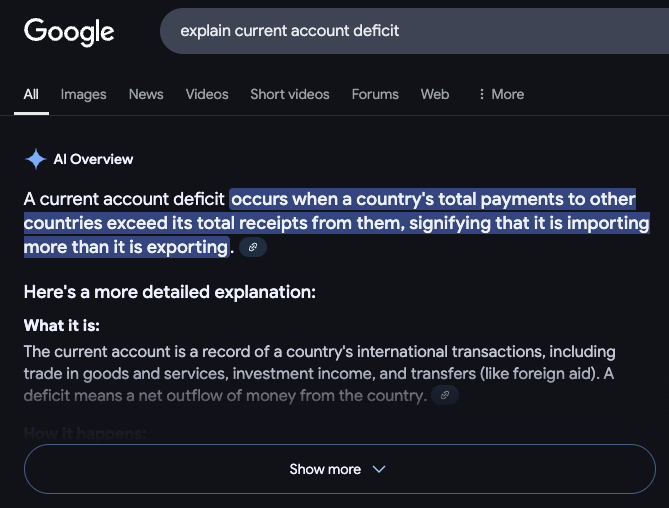
As an example, for some search terms, Google returns an AI Overview at the top of it’s search results, produced by it’s Gemini LLM.

I generally find the AI Overview useful and read it first, before scrolling down to other links and clicking on a few that look authoritative (e.g. IMF in this example) or informative (e.g. Wikipedia).
In today’s blog post, I look at the dedicated Chat Apps from major vendors, in terms of the types of LLMs available and the costs of using these.
ChatGPT – Model Selection
All Chat Apps, desktop, browser or mobile offer a prominent selector for specific LLMs, with a short tag line to help a user select the best one for their task.
ChatGPT’s model selector shows the below:

- GPT-4o is the default LLM with the description “Great for most questions”
- GPT-4o with scheduled tasks, is in Beta and offers recurring task prompts
- GPT-4.5 is the latest model and in Research Preview
- o1 uses advanced reasoning
- o3-mini is fast at advanced reasoning
- o3-mini-high, is great at coding and logic
- Under more models, are two older models
For a user, it is important to select the best model for their task.
Not only as the response is likely to be better, but because of the time taken and staying within usage limits (imposed due to compute costs).
In particular “reasoning models” break down a prompt into multi-steps and take much longer to complete, these are the o1 and o3 family of models.
Generally a user can expect to select from 3 or 4 types of LLMs:
- A default base model, for most use cases
- A reasoning model, for complex use cases
- A fast version of one or both of the above
- Specialised models e.g. for coding or maths or deep research
(Note, Deep Research is turned on by a specific selector below the chat prompt).
Claude and Gemini
Anthropic Claude, has the following types under its model selector.

- The default model is Claude 3.7 Sonnet
- The reasoning model is turned on by setting Thinking mode to Extended
- Fast version is Claude 3.5 Haiku
While Google Gemini has:

Again, we see Default and Reasoning, as well as Deep Research.
While if you were to use Google AI Studio, there are more Gemini models, including fast versions.
Pricing Plans
AI Chat Apps follow the standard SaaS model of offering a free plan (for trials or limited use) and paid plans for individuals, teams or enterprise.
ChatGPT pricing plans can be seen here and have the follow tiers:
- Free, limited access to models and usage
- Plus, $20 per month, limits on usage
- Pro, $200 per month, extended access
- Team, $25 per month per user
- Enterprise, contact sales
Claude Pricing is similar and available here and has all of the above tiers except Pro.
Google Gemini pricing is also similar and included in Google Workspace.
$20 per month is a common price point for many consumer subscription services.
While free tiers are okay for occasional personal use, they are very limited.
I find value in the Plus plan for at least one of ChatGPT or Claude, while Gemini is included with my Google Workspace account (Gmail, GDrive, GDocs etc.).
Usage, Pricing and APIs
Pricing plans also encourage appropriate and limited use of the “reasoning models”.
So ChatGPT Plus users are limited to sending 80 messages every 3 hours to GPT-4o and 50 messages a week to o1 and 50 messages a day to o3-mini.
The reason for this is the far higher compute required to produce responses from reasoning models. We can get a sense of the difference in magnitude of compute by looking at OpenAI API pricing:
- GPT-4o is $2.50 for Input, $1.25 Cached Input and $10 Output (per 1M tokens)
- o1 is $15 for Input, $7.50 Cached Input and $60 Output
A 6X difference in pricing for the higher compute costs required by reasoning models.
I am not going to go into API pricing in this post, but for those of you interested, please see the following links for details:
AI Chat App Revenues
We know that AI firms are earning a lot of revenue from these Chat Apps and this revenue is increasing rapidly month on month.
The largest by far is OpenAI which is estimated (by the NY Times) to have hit Annual Recurring Revenue (ARR) of $3.6 billion in August 2024, of which the majority is from ChatGPT and the remainder from other businesses using its technology. We don’t know the breakdown between Plan Tiers, but I expect Plus, Team and Enterprise will each be significant portions.
While Anthropic was estimated to have ARR of $1billion at end 2024, with API usage providing a larger share than the Claude App.
Learnings
AI ChatApps offer 3 or 4 LLMs.
- Default base model, for most tasks.
- Reasoning model, slower and expensive to compute.
- Fast model, quick to return (less parms)
- Specialised model (coding, maths,…)
Standard SaaS pricing with $20pm for the most common tier.
Usage limits on reasoning models, mean these have to be used sparingly.
Major vendors are generating rapidly increasing ARR from their Chat Apps, as more and more of us start to use the paid tiers.
Leave a Reply