
ChatGPT has a new Deep Research feature which I wanted to try, so I asked for an analysis to help me decide if my financial exposure to the S&P500 index should be maintained, increased or decreased.
Background
OpenAI recently introduced Deep Research, an agent that uses reasoning to synthesise large amounts of online information and complete multi-step research tasks. Deep research independently discovers, reasons about, and consolidates insights from across the web.
One of the domains Deep Research is targeted at is finance.
So let’s try it out.
Without Deep Research
First we need to know what happens without Deep Research, a control test.
In ChatGPT, with the default model GPT-4o selected, I entered:
I want an analysis to help me decide if I should maintain, increase or decrease my financial exposure to the S&P500 index
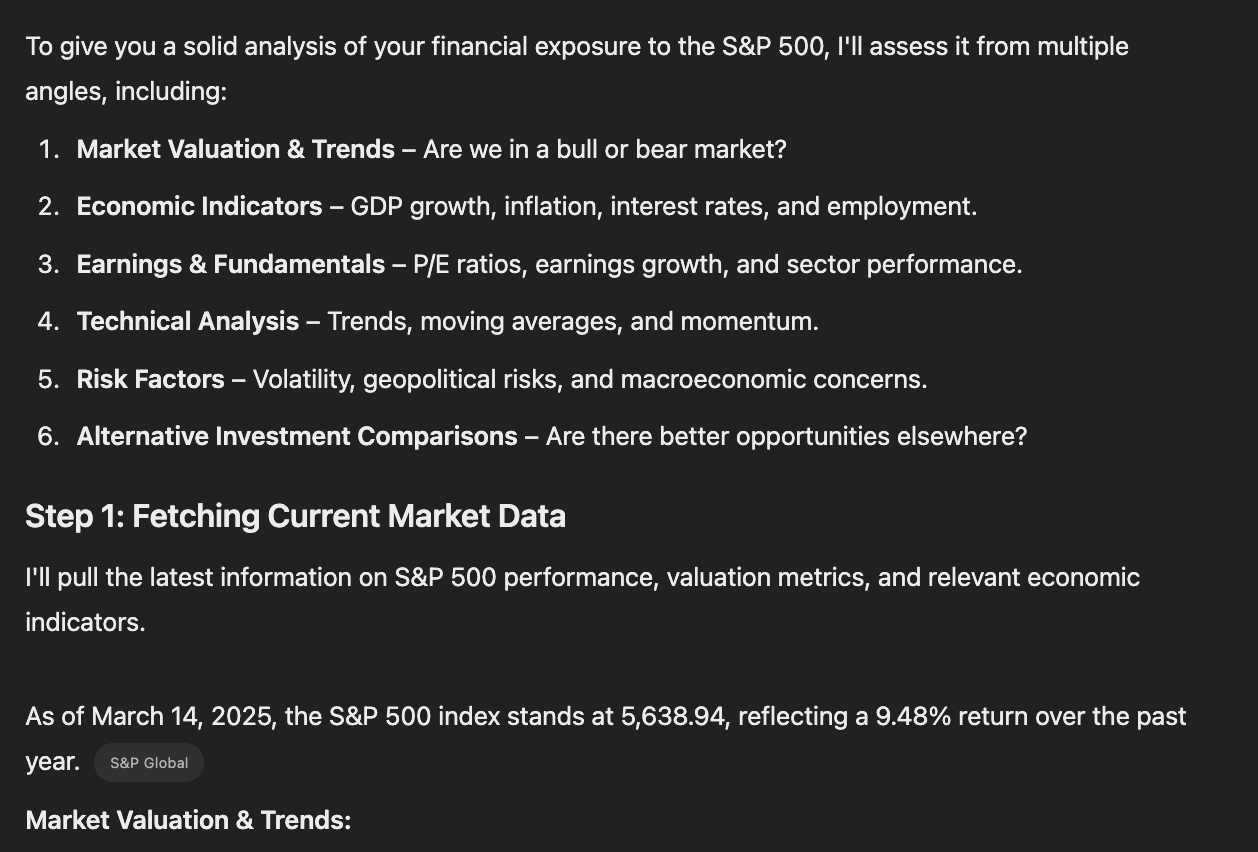
Straight-away I got the response:

(Partially re-produced above, the full text can be seen here).
What is wrong with this?
Well, I did not get prompted for any clarifications and the recommendation at the end is to maintain my existing S&P500 exposure, without any knowledge of what this is.
Hmm, I could have had 1% or 99% allocation!
Let’s now turn on Deep Research.
With Deep Research On
The response I get to the same prompt is:

Excellent, that is what I wanted, clarification questions, including ones on my investment horizon, risk tolerance and current allocation.
To these, I responded: medium term horizon, moderate risk tolerance and 35% current allocation to S&P500 as a percentage of assets.

(With hindsight, for the question on any other specific preferences, I should have said “UK domicile”, never mind, perhaps next time).
So what happened next?
I got the following.

And Starting Research with a progress bar.
Which proceeded slowly, showing me an indication of where and what it was doing.

Until 11 minutes of research later, I got the completion message.

Stating that 28 sources were used.
Before we look at the response, let’s list the sources.
Sources Used
- macrotrends.net
- cpram.com
- marketwatch.com
- bylinebank.com
- morganstanley.com
- jpmorgan.com
- fastbull.com
- advisorperspectives.com
- tradingeconomics.com
- reuters.com
- icrinc.com
- morningstar.com
- macquarie.com
- cnbc.com
Now many of these I recognise and trust but a number, no disrespect intended, such as cpram.com, bylinebank.com, advisorsperpective.com and icrinc.com are not known to me.
Some of these are referred to multiple times in the citations e.g. bylinebank.com, and cpram.com, which is concerning as looking at these specific websites does not give me confidence that they are sites I would go to or find in Google Search if I were doing this research manually.
Still, lets move onto the analysis response.
Analysis on S&P 500 Exposure
First point to note is that I got back a 12 page analysis, which is good.
The section headings are:
- Overview of Current Market Conditions Affecting the S&P 500
- Expected Performance and Risk-Adjusted Return Outlook (Medium Term)
- Macroeconomic Trends and Their Potential Impact on the S&P 500
- Diversification Considerations – Complementary Assets to the S&P 500
- Recommendation: Adjusting S&P 500 Exposure
I like these, they look good.
The full 12-pages of analysis is here.
So what do I think?
After spending 10-15 mins reading, I would say:
- It is long, with significant language repetition
- So would benefit from review and manual editing
- Makes a lot of good points, but not necessarily bang up to date
- So the Goldman Sachs S&P500 2025YE target is given as 6,500, which was recently lowered to 6,200 (11 March)
- Sound discussion on 2023 & 2024 returns, dominated by Mag 7, while more recent evidence of returns broadening out
- But at no point are US Tariffs and their potential impact mentioned
- Or any note on proposed US tax cuts and de-regulation
- Investor sentiment points do not reflect what we have seen in recent market moves or consumer confidence surveys
- No mention that the S&P500 is close to correction territory at down 8% from it’s high
- No charts in any of the 12 pages and just one table
- ……
- I could go on
But, why not first try and get ChatGPT to improve its 12 pages.
So I entered the following (with DeepResearch turned off):
Improve the attached document by removing repetition, increasing clarity and making more concise with sections 1 to 4, each with up to 600 words and section 5 with less than 400 words.
And the report clarity and length is indeed much better.
Section 1 is re-produced below.

Full text of the analysis can be seen here.
All reads much better, but the source links are no longer present.
And my above critique on tariffs, tax cuts, de-regulation and investor sentiment remain the same.
What of the recommendations?
Recommendation
The full text of this is below.

Maintain the 35% S&P 500 allocation.
That seems sensible to me.
I imagine the majority of investment analysts would agree.
Even if often easier to do nothing.
Elsewhere in the text (section 4), I see suggestions for diversification with Gold or Commodities 5-10%, Bonds 35-40%, International Equities 10-15%, REITS 5%.
Which for a medium horizon, medium risk tolerance and a US investor, look reasonable enough.
Thoughts
Would I be happy to read such a report from a wealth management firm?
Yes.
But it would be better with a few charts.
(A chart is worth a hundred words or more …).
I assume a few more prompts would get charts into the sections.
Investment firms that produce such analysis will have their own house standard.
And could use AI tools cognisant of this standard to produce new analysis.
I expect many are experimenting with or doing so already.
Learnings
Deep Research is far better for complex requests.
It asks for clarifications.Breaks down the requests into steps to research.
And goes away for many minutes.
Returning far quicker than a human researcher.
The response looks good and includes source references.
It can be verbose with some repetition.
So critical evaluation of the response is important.
Further prompts can be used to improve the clarity.
To get to a version you are happy with.
Leave a Reply